For the past few years, enterprise artificial intelligence has been in reactive, linear mode – a human user provides a prompt, the system produces an output, and the human manually validates and performs the next step. Conversational interfaces such as ChatGPT sped up individual output but kept an operational bottleneck in place that requires continuous human oversight to bridge the gaps between disparate software applications.
The technology landscape has officially evolved past passive conversational text. The enterprise ecosystem is transitioning rapidly into the era of Agentic AI—a paradigm shift from standard chat interfaces to autonomous, goal-oriented software agents engineered to execute complex, multi-step business operations independently.
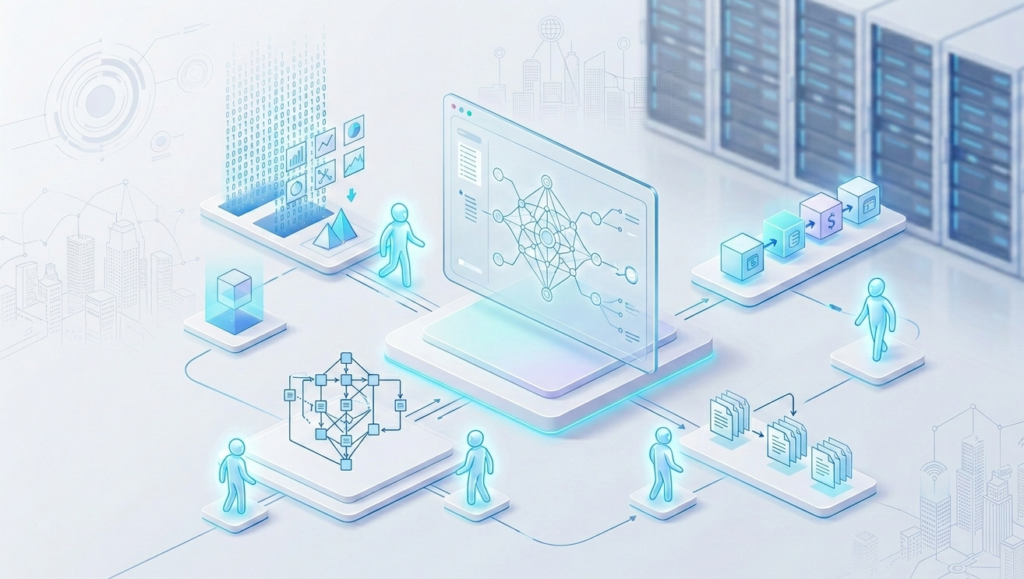
Unlike traditional AI tools, an agentic architecture operates continuously in the background. It integrates natively into existing enterprise software stacks, evaluates context-driven data, orchestrates specialized sub-agents, and dynamically self-corrects when encountering API or tooling failures.
For organizations seeking to transition from manual prompting to true background automation, five leading platforms are currently redefining enterprise workflows.
1. Microsoft Copilot Studio (Agentic Edition)
Organizations deeply anchored in the enterprise Microsoft ecosystem are leveraging the heavily upgraded infrastructure of Copilot Studio to build secure, autonomous multi-agent systems.
- Core Architecture: Operates beyond the standard Microsoft 365 sidebar assistant, allowing IT departments to deploy headless agents that execute tasks across Teams, SharePoint, and Dynamics 365.
- Workflow Integration: Automatically monitors incoming communication, cross-references unstructured documentation (such as vendor invoices or contracts), flags anomalies, and routes financial approvals through internal ERP networks without human intervention.
- Strategic Advantage: Offers enterprise-grade security and immediate compatibility for corporations that require strict data governance and secure cross-application coordination.
- Target Audience: Enterprise corporations native to the Microsoft cloud infrastructure.
2. Adopt AI
While competitive offerings frequently focus on combining conversational text with minor actions, Adopt AI delivers an “execution-first” framework designed entirely for silent, backend operation.
- Core Architecture: Utilizes system-level integrations and the Model Context Protocol (MCP), bypassing fragile UI screen-scraping methods in favor of executing direct backend logic.
- Workflow Integration: Autonomously tracks systemic imbalances—such as drops in supply chain warehouse metrics—discovers the necessary external vendor APIs, manages data translation, and places procurement orders independently.
- Strategic Advantage: Features automated error recovery; if an external server times out during a critical transaction, the platform calculates alternative routing solutions without halting operations.
- Target Audience: Operations, logistics, and supply chain management teams requiring invisible, reliable cross-system automation.
3. Kore.ai
Kore.ai has leveraged its established history in conversational AI to build one of the market’s most mature multi-agent orchestration frameworks for intricate departmental processes.
- Core Architecture: Employs a sophisticated multi-agent orchestration layer, utilizing specialized, separate models engineered to handle individual segments of a wider workflow.
- Workflow Integration: Deploys domain-specific blueprints for corporate infrastructure. During employee onboarding, a Documentation Agent verifies legal paperwork, securely transfers the verified profile to an IT Provisioning Agent to configure hardware assets, which then prompts a Scheduling Agent to organize team integrations.
- Strategic Advantage: Eliminates the computational drag of relying on a single, oversized LLM to handle diverse corporate tasks by relying on specialized digital micro-workers.
- Target Audience: High-volume Human Resources, IT Service Management (ITSM), and corporate customer operations.
4. UiPath Autopilot & Agentic Suite
UiPath has successfully bridged its multi-billion-dollar legacy in Robotic Process Automation (RPA) with the analytical reasoning capabilities of modern Large Language Models.
- Core Architecture: Upgrades rigid, rule-based software bots that traditionally clicked static screen elements into flexible systems capable of understanding unstructured data environments.
- Workflow Integration: Reads and processes non-standard business documents, reasons through fluctuating corporate compliance rules, and dynamically alters execution paths when data formats change unexpectedly.
- Strategic Advantage: Features an elegant “human-in-the-loop” protocol. If an agent detects an anomaly that exceeds its authorized compliance parameters, it packages the context for executive review and logs the human decision to inform its future logic.
- Target Audience: Established corporations transitioning legacy, brittle RPA systems into adaptive automation ecosystems.
5. n8n
For engineering and technical product teams that reject closed-source, “black box” enterprise applications, n8n offers a highly customizable, node-based open-source alternative.
- Core Architecture: A visual, developer-centric canvas designed to script precise multi-agent logic, allowing teams to determine exactly which LLM handles specific transactional nodes.
- Workflow Integration: Embeds stateful memory directly into complex technical pipelines, enabling engineering teams to build custom webhooks, secure database connections, and specialized internal tools.
- Strategic Advantage: Can be entirely self-hosted within private corporate clouds, allowing enterprises to bypass compliance challenges and vendor lock-in while ensuring sensitive data never leaves internal servers.
- Target Audience: High-growth technology startups, developers, and product teams demanding deep customization and total data sovereignty.
The Strategic Path Forward
The evolution from digital assistant to autonomous colleague signals a fundamental shift in operational scaling. Recent industry metrics confirm that automated machine-to-machine traffic across enterprise networks is growing exponentially, fundamentally altering how modern software ecosystems operate.
Implementing agentic AI platforms for business automation requires corporate leaders to rethink organizational design. Forward-thinking executives are no longer merely writing software specifications or managing human headcounts; they are managing a unified digital workforce. Organizations that successfully deploy these multi-agent workflows will decouple operational capacity from structural overhead, establishing a decisive competitive advantage over legacy competitors.