The architecture of the enterprise cloud is undergoing its third major generational shift. Cloud 1.0 was defined by the initial migration away from physical on-premise hardware to virtualized infrastructure. Cloud 2.0 optimized this foundation through microservices, containerization, and serverless computing. Today, the relentless explosion of generative artificial intelligence has brought us to the edge of Cloud 3.0—an era defined not just by hosting data, but by orchestrating massive, sustained compute power.
For tech firms, this transition has introduced a massive operational shock. The predictable, linear cost structures of standard SaaS hosting have been replaced by the volatile, compounding expenses of Graphic Processing Units (GPUs), specialized AI clusters, and massive data ingestion pipelines.
Running a single frontier model or fine-tuning a proprietary network can burn through capital at an unprecedented rate, forcing software engineering teams to completely rethink how they deploy software. To remain profitable in an AI-first market, forward-thinking tech firms are aggressively restructuring their infrastructure cost baselines.
The AI Compute Reality Shock
The primary driver behind Cloud 3.0 is a fundamental mismatch between traditional cloud budgets and the structural physics of machine learning.
- Continuous Under-the-Hood Workloads: Unlike standard web applications that experience predictable traffic spikes and sit idle at night, AI models demand continuous, massive token processing power during inference, data vectorization, and active training phases.
- The Premium GPU Premium: Specialized hardware arrays (like NVIDIA’s H100 and B200 architectures) remain scarce and expensive. Relying purely on legacy cloud providers for raw, on-demand GPU access introduces massive markup penalties.
- Exploding Data Ingress/Egress Fees: To remain contextually relevant, AI architectures require constant interaction with massive datasets, real-time vectors, and third-party APIs. Moving these massive data payloads across unoptimized cloud environments generates crippling data transit fees.
Infrastructure Cost Breakdown: Cloud 2.0 vs. Cloud 3.0
To visualize how drastically budgets are shifting, engineering executives are using this comparative matrix to benchmark their re-allocations:
| Cost Vector | Cloud 2.0 Architecture (Legacy SaaS) | Cloud 3.0 Architecture (AI-First) | Financial Impact Shift |
| Primary Compute | Commodity CPU Virtual Machines (VMs) | High-Performance GPU Clusters & TPUs | 3x to 5x increase in baseline compute spend |
| Data Architecture | Standard Relational Databases (SQL) | Real-Time Vector Databases & Knowledge Graphs | Higher storage costs, specialized ingestion pipelines |
| Pricing Models | Linear pay-as-you-go based on active users | Non-linear token-based billing or reserved instances | Drastic shifts from operational expense to committed capital |
| Network Traffic | Standard payload transfers and CDNs | High-volume semantic embeddings and continuous API syncs | Explosive growth in data transit and egress liabilities |
Strategic Playbooks: Restructuring Infrastructure for the AI Era
To protect margin health without slowing down product innovation, engineering, and finance leaders are deploying three core technical playbooks:
1. Embracing the “Hybrid Cloud” Model
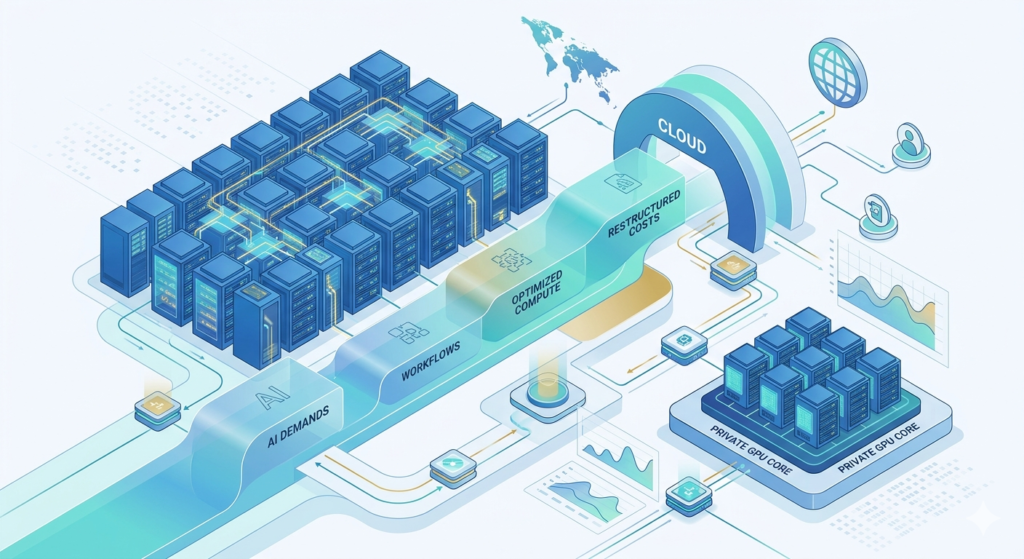
The complete reliance on a single public hyper-scaler (like AWS, Google Cloud, or Microsoft Azure) is giving way to pragmatic, multi-cloud and hybrid environments. Tech firms are splitting their workloads based on operational characteristics:
- The Public Edge: Using major hyper-scalers strictly for customer-facing application frontends, global delivery networks (CDNs), and fluctuating user inference endpoints.
- The Private Core: Renting bare-metal GPU clusters from niche, AI-focused infrastructure providers (such as CoreWeave or Lambda Labs) or purchasing dedicated on-premise clusters for core model training where raw hardware ownership dramatically undercuts public cloud margins over an 18-month timeline.
2. Algorithmic and Structural Optimization
Tech firms are learning that throwing more hardware at an AI application is an unsustainable substitute for clean engineering. Massive efficiency gains are being captured by optimizing how models are executed:
- Quantization and Model Pruning: Shrinking high-parameter models down to 8-bit or 4-bit representations. This slashes the memory and compute footprints required for inference by up to 60% with negligible losses in response accuracy.
- Small Language Models (SLMs): Instead of using a multi-billion-parameter general LLM for a simple task like parsing an email or categorizing a support ticket, firms are deploying hyper-focused, domain-specific SLMs that can run cheaply on lightweight commodity hardware.
- Semantic Prompt Caching: Implementing advanced caching layers that intercept user requests. If an AI system detects a query that is semantically identical to a recent request, it serves the cached response instead of running a brand-new, costly inference loop on the GPU cluster.
3. Implementing Rigid “FinOps for AI” Controls
Traditional financial operations (FinOps) metrics are poorly equipped to handle the realities of AI. Modern tech organizations are establishing granular guardrails to link compute usage directly to business metrics:
- Token Attribution Tagging: Attributing every API and GPU cluster call back to specific customer IDs, products, or feature sets. This lets management identify exactly which features are highly profitable and which are burning capital.
- Automated GPU Auto-Scaling: Ensuring that specialized AI nodes dynamically spin down or reallocate to lower-priority batch processing jobs when real-time user inference demands drop.
- Strict Inference Quotas: Setting dynamic, user-tier caps on generative features to prevent malicious actors or power users from generating thousands of expensive backend compute requests that erode unit economics.
Conclusion: The New Bottom-Line Paradigm
The transition to Cloud 3.0 is not an IT challenge; it is a fundamental business model evolution. Tech firms that treat AI compute as an unoptimized cloud expense will find themselves trapped in a cycle of diminishing margins and unsustainable capital burn.
The future belongs to the organizations that view infrastructure as a core strategic lever. By diversifying cloud environments, ruthlessly optimizing model efficiency, and enforcing strict FinOps frameworks, tech firms can successfully restructure their cost bases. Doing so unlocks the true, uninhibited scalability of artificial intelligence, allowing it to deliver massive value to its markets while maintaining robust enterprise profitability.