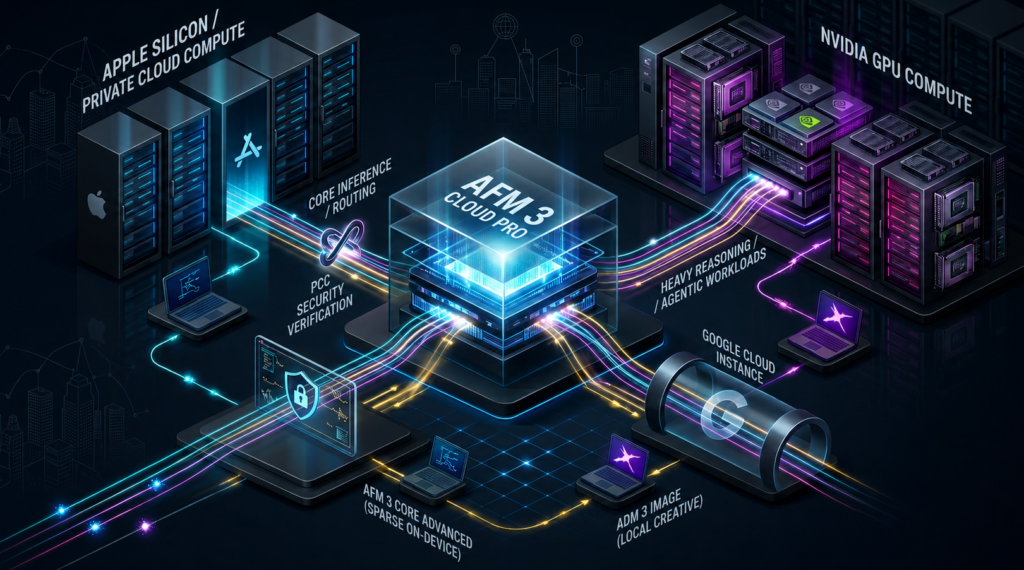
The unveiling of Apple’s third-generation Apple Foundation Models (AFM 3) marks a massive technological leap forward for the company’s ecosystem, but it simultaneously exposes a fascinating contradiction in modern enterprise strategy. While the tech giant heavily promotes an independent, privacy-centric narrative centered on its custom Apple Silicon and Private Cloud Compute (PCC), the architectural reality behind its most demanding AI workloads tells a completely different story. To power its heaviest agentic and complex reasoning features.
Apple has actively built its premium AFM 3 Cloud Pro framework directly on Nvidia GPUs hosted within Google Cloud data centers, while additionally refining the software using data points distilled straight from Google’s frontier Gemini models. This striking operational paradox proves that in the modern, hyper-expensive landscape of generative engineering, even the world’s most fiercely independent hardware manufacturer must ultimately cross enemy lines and lean on competitor infrastructure to survive the frontier AI race.
The Structural Breakdown of the AFM 3 Ecosystem
To understand why Apple stepped outside its own ecosystem, we must first examine how the newly announced third-generation architecture is organized. The AFM 3 family is not a single, monolithic model; rather, it is a highly specialized five-model framework split between local hardware and cloud systems:
- AFM 3 Core: A compact, 3-billion-parameter dense model designed to run entirely on local Apple Silicon, handling fast natural language processing and lightweight routing.
- AFM 3 Core Advanced: A highly innovative, 20-billion-parameter on-device model. It utilizes an advanced sparse architecture—activating only 1 to 4 billion parameters at any given moment depending on the prompt—allowing massive mobile capabilities to run natively out of a device’s flash memory instead of overwhelming the DRAM.
- AFM 3 Cloud: The standard, server-side workhorse engineered specifically for high-speed multimodal text and reasoning pipelines within Apple’s proprietary Private Cloud Compute nodes.
- ADM 3 Cloud (Image): A specialized cloud-based diffusion model built entirely for local image generation, photo editing, and Apple’s new creative applications.
- AFM 3 Cloud Pro: The undisputed heavyweight of the entire lineup, engineered specifically to manage continuous multi-step reasoning, complex coding, and autonomous enterprise agentic workflows.
Why Apple Crossed Enemy Lines for Cloud Pro
While the first four models in the AFM 3 ecosystem are completely optimized to run on custom Apple Silicon, AFM 3 Cloud Pro stands out as a stark architectural exception. Apple explicitly acknowledged that this flagship cloud model abandons proprietary server setups, opting instead to run on high-performance Nvidia GPUs hosted directly inside Google Cloud instances. Several critical business and engineering factors forced this unusual infrastructure choice:
The Realities of Frontier Scale
Building proprietary data infrastructure capable of rivaling hyperscalers takes decades and hundreds of billions of dollars. Google Cloud provides immediate, infinite computational scaling that Apple’s in-house server grids simply cannot replicate on a tight product release timeline.
The Nvidia Bottleneck
Advanced agentic tool use and continuous reasoning require specialized hardware clusters. While Apple Silicon is a masterpiece for local efficiency and edge computing, Nvidia’s enterprise GPU architecture remains the global gold standard for hyperscale cloud inference.
The Knowledge Distillation Shortcut
Training a frontier-class model from scratch requires immense time. Apple bypassed this hurdle by utilizing data outputs from Google’s own frontier Gemini models to perform post-training distillation and structural refinement on AFM 3 Cloud Pro, drastically accelerating its performance.
The Security Solution: Extending Private Cloud Compute
Leaning heavily on a major competitor’s infrastructure creates a massive public relations and security dilemma for a company that stakes its brand reputation on absolute user privacy. To resolve this, Apple’s security engineering teams had to aggressively extend the cryptographic boundaries of their Private Cloud Compute (PCC) directly into Google’s physical data centers.
- Immutable Fleet Ledgers: Apple maintains a cryptographically signed, completely unalterable append-only ledger that tracks every single piece of third-party hardware provisioned for its fleet. This prevents any unauthorized or unverified server nodes from being silently introduced into the network.
- Multi-Vendor Multi-Root Attestation: For any critical sub-component that could theoretically leak data if compromised, Apple requires independent cryptographic compliance from at least two entirely separate hardware vendors. This ensures that even if one vendor’s security is breached, user data remains fully encrypted.
- Zero-Privileged Access Guarantees: The software stack running on the Google Cloud nodes is completely stateless and fully audited. Neither Google’s system administrators nor Apple itself possesses administrative keys or overrides to peer into user data or inspect active reasoning logs.
Key Takeaways for Technical Leaders
The surprising partnership underneath the AFM 3 ecosystem offers profound, foundational lessons for enterprise technology leaders navigating their own architectural roadmaps:
- Prioritize Pragmatism Over Pride: Apple holds an iron-clad grip on its hardware identity, yet it readily chose to rent infrastructure from its direct smartphone rival. In the AI era, speed-to-market and computational availability must always take precedence over corporate tribalism.
- Play to Your True Moats: Apple recognized that its true competitive advantage sits directly at the edge—building specialized 20B sparse architectures that run smoothly inside consumer pockets. They successfully deferred the generic, heavy cloud lifting to specialized hyperscalers.
- Enforce Security via Code, Not Contracts: Instead of blindly trusting Google’s corporate privacy policies, Apple protected its users by deploying strict cryptographic verification, multi-root hardware validation, and verifiable software builds. Trust should always be established mathematically, never contractually.
Ultimately, the AFM 3 infrastructure paradox proves that the future of enterprise artificial intelligence is deeply interdependent. In a landscape where scaling demands are absolute, even the tech industry’s fiercest rivals must become cooperative allies behind the data center doors.
Conclusion
The structural relationship underpinning the AFM 3 ecosystem fundamentally proves that the future of enterprise AI will be defined by interdependent ecosystems rather than isolated, proprietary silos. By exporting its strict Private Cloud Compute (PCC) protections onto Nvidia hardware inside Google Cloud data centers, Apple has introduced a groundbreaking infrastructure design pattern: portable, cryptographic trust that operates independently of the underlying cloud provider.
This historic shift demonstrates that scaling frontier-grade intelligence requires absolute computational pragmatism, forcing even the world’s most fiercely insular hardware company to treat former competitors as critical infrastructure allies. Ultimately, the true winners of the generative era will not be those who attempt to build everything in-house, but rather the strategic leaders who seamlessly bridge cross-platform capabilities while maintaining uncompromised, verifiable security boundaries at the edge.